

As electronic devices become smaller, more powerful, and have more demanding technical properties, the role of potting materials has never been more important. Whether you’re protecting transformers, power modules, EV components, LED drivers, or sensitive control boards, selecting the right material (epoxy or silicone) has a direct impact on performance, manufacturing efficiency, and long‑term reliability.
Manufacturers evaluating epoxy vs. silicone for electronic protection materials must consider not only the chemistry of each system but also how they align with electrical insulation, thermal management, environmental resistance, and processing requirements. Add to this the increasing availability of RTV silicone potting compounds, polyurethane potting compounds for electronics, and specialty materials like electrically conductive potting compounds, and you have a complex, but solvable, selection challenge.
This guide breaks down the differences between epoxy and silicone, explains where each excels, and highlights two proven solutions: Insulcast® RTVS 27 and Insulcast 116 FR, for engineers seeking high‑performance, reliable potting materials.
Epoxy Potting Compounds: When Strength, Rigidity, and Chemical Resistance Matter
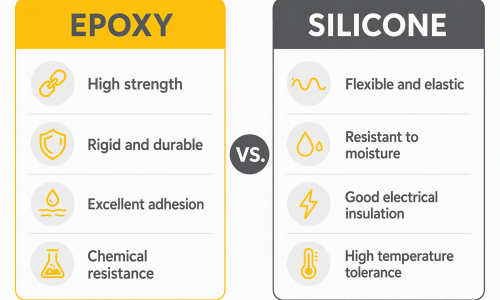
Epoxies remain the most widely used potting materials in high‑demand electronics manufacturing. They are known for their strong adhesive properties, rigid cured structure, and excellent chemical resistance.
Epoxy systems are commonly selected for:
- Applications requiring IP protection
- Transformers, where transformer potting thermal management must handle heat buildup
- Power electronics exposed to oils, fuels, or harsh chemicals
- Applications requiring structural support
Because epoxies cure into a stiff, cross‑linked network, they provide mechanical reinforcement. This makes them ideal for protecting components from vibration or mechanical shock across industrial, automotive, and aerospace electronics.
When to Choose Epoxy
Choose an epoxy potting compound when your application requires:
- Excellent chemical and moisture resistance
- Strong adhesion to metals and plastics
- Dimensional stability
- IP Protection
- Flame retardancy (in certain specialty formulas)
A good example is Insulcast 116 FR, a flame‑retardant epoxy potting compound engineered for demanding electrical environments. This system is optimized for excellent dielectric protection, reliable performance under thermal load, and high mechanical durability. It is a strong choice for applications like power supplies, converters, transformers, and mission‑critical industrial controls.
Silicone Potting Compounds: Flexibility, Wide Operating Temperatures, and Environmental Resistance
While epoxies deliver rigidity, silicones provide flexibility, wide temperature stability, and excellent moisture resistance, qualities that make them indispensable in many sensitive or high‑thermal‑cycling electronics.
Room Temperature Vulcanized (RTV) silicone potting compounds offer room‑temperature curing, easy processing, and long‑term resilience. They excel when components expand and contract due to thermal cycling, or when vibration and movement must be absorbed rather than resisted.
Advantages of Silicone Potting Compounds
- Wide operational temperature window (often -55°C to 200°C+)
- Superior moisture and humidity resistance
- Soft, stress‑relieving cured structure
- Excellent electrical insulation
- Fast, convenient RTV potting options
- Ideal for delicate SMT components or thermally sensitive devices
One standout product is Insulcast RTVS 27, a premium RTV silicone potting compound designed for electronics exposed to extreme conditions. Insulcast RTVS 27 provides exceptional dielectric strength, high heat resistance, and long‑term environmental stability. Because it cures to a flexible gel‑like material, it reduces strain on solder joints, wires, and delicate circuitry. Insulcast RTVS 27 is also highly customizable providing solutions for various potting needs.
This makes RTVS 27 a compelling choice for:
- Outdoor electronics and sensors
- LED drivers and lighting modules
- High voltage power supplies
- Power supplies in fluctuating environments
- High‑moisture or condensation‑prone locations
Polyurethane Potting Compounds: A Middle‑Ground Solution
Though the main comparison here is epoxy vs. silicone, remember that polyurethane potting compound for electronics offers a balanced alternative: tougher than silicone but more flexible than epoxy. PUs are often chosen for consumer products, automotive electronics, and encapsulation where cost efficiency and vibration resistance are key.
Electrically Conductive Potting Compounds: A Specialty Category
In certain applications, EMI shielding, grounding pathways, and RF‑sensitive assemblies, engineers rely on electrically conductive potting compounds. These formulations incorporate conductive fillers (such as silver, nickel, or carbon) to achieve defined electrical pathways while still protecting components. Conductive systems can exist in both epoxy and silicone chemistries, depending on the mechanical and thermal needs of the assembly.
Epoxy vs. Silicone: How to Choose the Right Material
When selecting between epoxy and silicone for electronics potting applications, consider the following criteria:
- Thermal Management
- Epoxy typically handles heat conduction better due to its rigid structure and available thermally conductive fillers.
- Silicone tolerates higher operating temperatures and excels in thermal cycling.
- Mechanical Requirements
- Epoxy provides rigidity and structural stability.
- Silicone absorbs vibration and mechanical stress.
- Environmental Conditions
- Silicone dominates when moisture, humidity, or extreme temperature swings are unavoidable.
- Epoxy performs best in fuel‑exposed or chemical‑rich environments.
- Processing Needs
- RTV silicone potting compounds can often be utilized in 1:1 mixing ratios and cure at room temperature with decreased curing times at elevated temperatures
- Epoxies can often have a more flexible cure schedule depending on the Stage B options but may not be 1:1 mixing ratios
- Application Sensitivity
- Silicones protect delicate solder joints from stress.
- Epoxies reinforce assemblies needing mechanical hardness.
Product Spotlight: Insulcast RTVS 27 & Insulcast 116 FR
Insulcast RTVS 27 – Premium RTV Silicone for Demanding Electronics
This RTV silicone potting system is designed for electrical and electronic encapsulation requiring flexibility, moisture resistance, and thermal stability. Ideal for high‑reliability devices exposed to vibration or environmental fluctuations.
Key benefits:
- Excellent dielectric properties
- Soft, stress‑relieving cure
- Great for outdoor or temperature‑cycling applications
- Superior humidity and moisture protection
Insulcast 116 FR – Flame‑Retardant Epoxy for High‑Performance Electronics
A flame‑retardant epoxy potting compound engineered for power electronics, transformers, converters, and industrial controls.
Key benefits:
- High mechanical strength
- Superior chemical and moisture resistance
- Excellent thermal performance
- Flame‑retardant formulation for safety‑critical designs
Together, Insulcast RTVS 27 and Insulcast 116 FR give engineers a versatile toolbox for solving potting challenges across industries, from automotive to renewable energy to consumer electronics.
Conclusion
Choosing between epoxy and silicone for electronics potting applications depends on the balance of mechanical strength, thermal needs, environmental exposure, and component sensitivity. Epoxies like Insulcast 116 FR deliver structural integrity and flame‑retardant performance for power‑dense electronics, while silicones like Insulcast RTVS 27 provide flexibility, reliability, and moisture resistance for dynamic or harsh environments.
Understanding your application’s thermal budget, mechanical stresses, and environmental conditions is the key to selecting the right material and ensuring long‑term performance of the electronics you design.
By: Andrew Kastner, Product Manager and Sarah Vigue, Marketing Specialist
View all our Technical Data Sheets and Safety Data Sheets. Need some help? Ask a technical question and find a solution!
For more information like this, follow ITW Performance Polymers on LinkedIn and sign up for enewsletter in our website footer.