

What Happens After the Bead Is Dispensed Matters
When two adhesives look similar in the package it is tempting to treat them as interchangeable, even if the price tags are different. But the true cost of a structural adhesive is not only defined by its cost per container. It is revealed by its quality, and ultimately, in the quality of the finished bond.
A recent side-by-side demonstration made that difference visible.
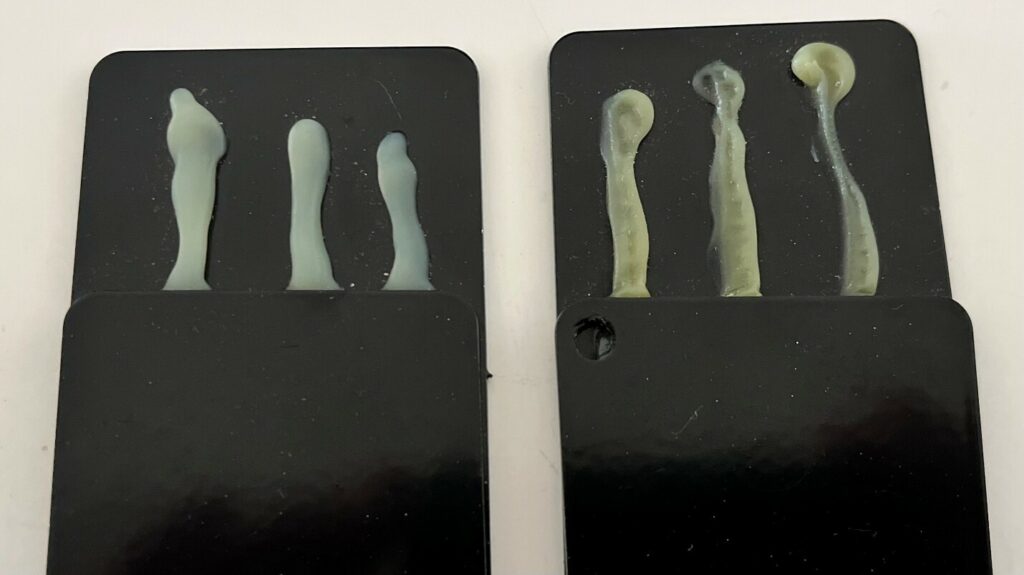
Three small beads of Plexus MA300 were dispensed next to beads of a lower-cost, lookalike adhesive. Each bead began at approximately the same size. But, as the materials cured, their behavior diverged.
The Plexus MA300 beads retained their shape and maintained a consistent appearance. The alternative material visibly shrank and discolored. Although this demonstration was observational rather than a standardized laboratory test, the result gave operators an immediate, tangible view of why adhesive quality matters.
A Small Bead Can Reveal a Much Larger Risk
Shrinkage is not merely a cosmetic concern. When an adhesive loses volume during cure, it may no longer fill a joint as intended. Depending on the application, that can contribute to:
- Incomplete gap filling
- Voids or gaps within the bond line
- Lower strength bonds
- Increased risk of surface distortion or read-through
- Greater variability in the finished assembly
Visible inconsistencies should prompt a closer examination of the material’s formulation, technical documentation, quality controls, and validated performance.
In structural bonding, “close enough” may introduce risks that are not apparent until after production.
Engineered for Reliable Structural Bonding
Plexus MMA adhesives are two-part methacrylate adhesive designed for the structural bonding of thermoplastic, metal, and composite assemblies. Mixed at a 1:1 or 10:1 ratios, have a range of working and cure times to fit most applications. Dispensed as a non-sagging gel, Plexus adhesives reliably fill gaps from 0.25 to 38 millimeters.
That combination of properties helps manufacturers achieve controlled application and reliable bond-line coverage across a range of assembly conditions.
Key advantages include:
High strength, durability, low shrink, energy absorption and structural stiffness
Plexus MA300 is formulated to deliver the strength required for demanding structural applications. Its published typical cured tensile strength ranges from 3,510 to 4,290 psi, or 24.2 to 29.6 MPa.
Broad material compatibility
The adhesive is designed to bond a wide variety of thermoplastics, metals, and composite materials. Published substrate data includes aluminum, stainless steel, PC/ABS, gelcoat, and PVC, though actual performance depends on the substrates, joint design, preparation, and application conditions.
Practical working and strength-development profile
At approximately 74°F, or 23°C, the product has a published working time of three to six minutes. It reaches approximately 500 psi in 11 to 13 minutes and 1,000 psi in 13 to 16 minutes.
This balance gives operators time to dispense and position components while supporting efficient movement through the assembly process.
Non-sagging application
Because Plexus MA300 is dispensed as a non-sagging gel, it can remain where it is applied rather than flowing away from the intended bond area. This is especially valuable when maintaining consistent adhesive placement and joint fill is critical.
Multiple packaging options
The product is available in ready-to-use 50 mL and 400 mL cartridges as well as 5-gallon and 50-gallon bulk formats, supporting everything from manual application to larger meter-mix-dispense operations.
A Lower Purchase Price Does Not Always Mean a Lower Total Cost
A knock-off adhesive may appear attractive when the initial price is the primary point of comparison. But the cost of an adhesive is only one part of the manufacturing equation.
If an alternative material shrinks excessively, cures inconsistently, produces unacceptable read-through, or fails to fill the joint properly, the resulting costs can include:
- Rework and scrap
- Additional inspection
- Slower production
- Cosmetic defects
- Bond-line variability
- Field repairs or warranty exposure
- Lost confidence from operators and customers
These downstream consequences can quickly outweigh the savings associated with a lower-priced material.
There may also be uncertainty when products are relabeled or sold through channels that make the original manufacturer difficult to identify. Manufacturers should know who formulated the adhesive, who controls its production, what testing supports its published properties, and whether batch-level traceability and technical support are available.
A label can imitate branding. It cannot substitute for documented formulation control, repeatable manufacturing, application expertise, or validated technical performance.
Quality You Can See and Performance You Can Verify
The side-by-side cured beads offered a simple but compelling lesson: products that appear similar before dispensing may behave very differently once the chemical reaction begins.
Plexus MA300 is supported by published technical data covering its mix ratio, working time, strength development, cured mechanical properties, gap tolerance, and performance on multiple substrates. That documentation gives engineers and production teams a defined basis for material selection, process development, and application testing.
When the integrity and appearance of the finished assembly matter, adhesive selection should not be based on price or packaging alone. It should be based on proven performance, consistent quality, technical transparency, and confidence that the material will do what it promises to do.
The difference becomes especially clear after the cure.
By: Kry Wesselink, Product Manager EMEA
View all our Technical Data Sheets and Safety Data Sheets. Need some help? Ask a technical question and find a solution!
Further reading: Thixotropy, Viscosity and Rheology … Oh my! and What is fixture time anyway?.
For more information like this, follow ITW Performance Polymers on LinkedIn and sign up for enewsletter in our website footer.
ITW Performance Polymers is an international leader in structural adhesives, grouting and chocking compounds, and wear-resistant coatings and repair products. Contact us to learn more about these products and their applications.