

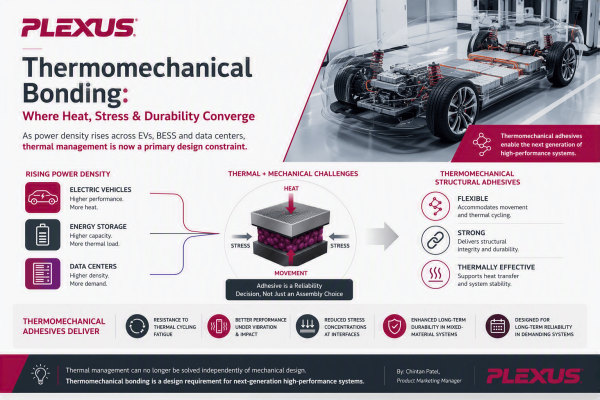
As power density continues to rise across electric vehicles (EVs), battery energy storage systems (BESS), and data centers, thermal management has evolved from a secondary consideration into a primary design constraint.
Engineers are no longer solving isolated heat problems, they are designing integrated systems where thermal loads, mechanical stress, and long-term durability intersect.
Thermal Challenges Are No Longer Just About Heat
Traditionally, thermal challenges have been addressed through cooling systems, heat sinks, and thermal interface materials. While these solutions remain essential, they overlook a critical reality:
The structures surrounding heat-generating components are continuously exposed to thermal cycling, vibration, and material mismatch.
In these environments, adhesive selection becomes a reliability decision, not just an assembly choice.
The Rise of Thermomechanical Demands
EV battery packs, energy storage modules, and power electronics enclosures share common challenges:
- Materials expand and contract at different rates
- Metals are bonded to plastics and composites
- Thermal gradients persist during operation
Over time, rigid bonding solutions may provide initial strength but often struggle under repeated thermal strain.
This has driven the need for thermomechanical structural adhesives, materials that combine load-bearing strength with stress absorption and controlled heat transfer.
Why Polyurethane Structural Adhesives
Polyurethane structural adhesives occupy a unique space between rigid structural systems and soft thermal materials.
Their elastomeric nature allows them to accommodate movement without cracking, while still delivering the structural integrity required for demanding assemblies.
This balance enables:
- Improved resistance to thermal cycling fatigue
- Better performance under vibration and impact
- Reduced stress concentrations at bonded interfaces
- Enhanced long-term durability in mixed-material systems
When designed correctly, polyurethane adhesives support both mechanical reliability and thermal system stability.
A Portfolio Approach to Thermomechanical Bonding
Not all systems impose the same demands. The Plexus® polyurethane portfolio enables engineers to align adhesive performance with application requirements:
- Plexus DT2325 → Designed for flexibility-driven applications where movement and thermal cycling dominate
- Plexus DT2430 → Balanced structural performance with functional thermal support
- Plexus DT2630LD → High thermal conductivity for systems where bonded interfaces contribute to heat transfer
This portfolio approach ensures the adhesive is not just compatible, but optimized for system-level performance.
Supporting the Next Generation of Systems
As data centers scale for AI workloads and energy storage systems expand globally, reliability expectations continue to increase.
Thermal management can no longer be solved independently of mechanical design.
Adhesives must function as part of the system, managing stress, supporting heat dissipation, and maintaining integrity over time.
Designing for Long-Term Reliability
Whether in EVs, energy storage, or data center infrastructure, long-term reliability depends on how systems handle both heat and movement over years of operation.
Thermomechanical structural bonding is no longer optional.
It is becoming a design requirement for next-generation high-performance systems.
By: Chintan Patel, Product Marketing Manager
View all our Technical Data Sheets and Safety Data Sheets. Need some help? Ask a technical question and find a solution!
Further reading: Thixotropy, Viscosity and Rheology … Oh my!, What is fixture time anyway?, and Is it strong enough?.
For more information like this, follow ITW Performance Polymers on LinkedIn and sign up for enewsletter in our website footer.
ITW Performance Polymers is an international leader in structural adhesives, grouting and chocking compounds, and wear-resistant coatings and repair products. Contact us to learn more about these products and their applications.