

Post Takeaway:
Epoxy and cementitious grouts behave fundamentally differently due to their chemistry (hydration versus polymerization) driving differences in strength, adhesion, curing, and long-term stability. While cementitious grouts can perform well in static, non-aggressive applications, they remain sensitive to water content and curing conditions. Epoxy grouts provide more consistent curing, stronger adhesion, and better resistance to dynamic loads and chemical exposure, making them well suited for demanding industrial environments. Ultimately, selecting the right grout depends on application requirements, particularly load type, environment, and long-term alignment stability.
When specifying grout for equipment foundations, one of the most common questions is:
What’s the real difference between epoxy grout and cementitious grout and why does it matter?
At a glance, both materials may appear to serve the same purpose. However, the difference between epoxy and cement grout goes far beyond composition. These materials behave very differently in terms of strength, curing, adhesion, and long‑term performance.
Understanding these differences is critical when deciding when to use epoxy grout vs cement grout, especially in demanding industrial environments.
It Starts with Chemistry: Why Epoxy and Cement Grouts Act Differently
The most fundamental difference in the epoxy grout vs cementitious grout comparison is how each material is formed.
Cementitious grout is a mixture of cement, water, and aggregates. Its properties depend heavily on water content and hydration reactions.
Unlike cementitious grouts, epoxy grouts do not gain properties through hydration. They cure by polymerization and cross-linking, which is why they behave so differently in terms of strength development, adhesion, and return-to-service time.
This difference in chemistry drives everything else—from flow behavior to epoxy grout cure time and final mechanical performance.
Put simply:
- Cement grout = water-dependent system
- Epoxy grout = chemically controlled system
Strength Comparison: It’s Not Just Compressive Strength
One of the most talked-about differences in any epoxy vs cement grout strength comparison is compressive strength—and for good reason.
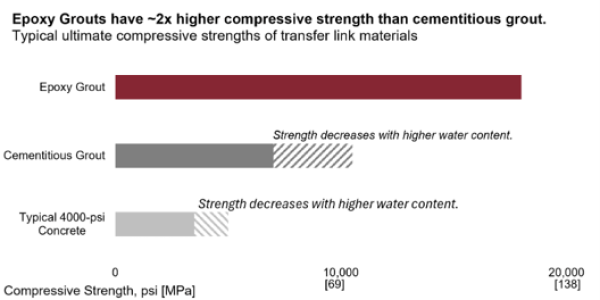
That’s a significant step change. But compressive strength alone doesn’t tell the full story. For equipment foundations, compressive strength alone can be misleading because failure modes are more often driven by tensile stresses, bond integrity, and dynamic loading—not pure compression.
Where Epoxy Really Separates Itself
Here are more ways that epoxy grout compares to cement formulations…
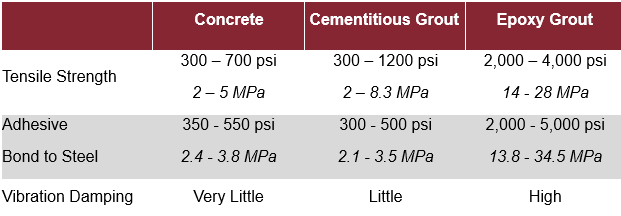
This is why industrial epoxy grout is typically selected for rotating equipment. For example, in high-speed compressor applications, epoxy grout is often selected to maintain alignment under continuous dynamic loading. It doesn’t just support loads, it resists dynamic forces and maintains alignment over time.
Shrinkage vs Stability: The Truth About “Non-Shrink”
The term non-shrink construction grout can be misleading if not fully understood.
Cementitious grouts are often labeled “non-shrink,” but in reality:
- Their volume stability is still influenced by water content
- Drying, bleed water, and curing conditions can all lead to dimensional changes
By comparison:
- Non shrink epoxy grout systems have extremely low shrinkage (≤ 0.10%)
- They are not water-dependent, so they maintain predictable volume stability
While properly specified and installed cementitious grouts can perform well, their volume stability remains more sensitive to water content and curing conditions. This difference is critical when evaluating non shrink grout vs epoxy grout, especially for precision equipment where even small movements matter.
Cure Behavior: Hydration vs Chemical Reaction
Another major difference is how the materials cure—and how quickly they return to service.
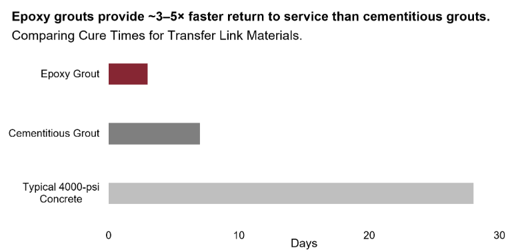
This difference in epoxy grout cure time is one of the biggest advantages in industrial settings.
Why It Matters
- Faster return to service reduces downtime
- Chemical curing ensures more consistent properties
- Performance is less dependent on environmental moisture
This is especially valuable when planning outages and determining how to install epoxy grout efficiently while minimizing delays.
Adhesion and Load Transfer: A Critical Difference
One of the most overlooked aspects in an industrial grout comparison (epoxy vs cement) is adhesion.
Cementitious grouts:
- Have low bond strength to steel
- Primarily rely on gravity and friction for load transfer
Epoxy grouts:
- Have very high adhesive bond strength
- Effectively “lock” equipment to the foundation
This is why products like Chockfast epoxy grout are used in key applications, such as the foundations for critical path assets—hypercompressors, turbines, and pumps.
Better adhesion results in:
- Improved load distribution
- Reduced micro-movement
- More stable equipment alignment
Chemical Resistance: Where Cement Falls Short
In many industrial environments, exposure to oil, chemicals, or moisture is unavoidable.
While understanding that performance will depend heavily on the specific chemical exposure and formulation, a general comparison of the chemical resistance of epoxy grout vs cement grout:
- Cementitious materials are porous and can degrade over time
- Epoxy grouts are non-porous and chemically resistant
This makes epoxy the preferred choice for:
- Oil & gas facilities
- Chemical processing and refining plants
- Power generation facilities
- Pulp & paper mills
- Mining and mineral processing plants
Installation Differences: Why Epoxy Requires a Different Approach
When comparing how to install epoxy grout vs cement grout, one of the biggest differences is workability and expectations.
- Cement grout = water-dependent flow
- Epoxy grout = a high-viscosity (‘lumpy oatmeal’) consistency
Because epoxy systems are sensitive to temperature, mix ratio, and placement technique, installation quality has a direct impact on final performance. Since epoxy does not behave like a fluid, it must be:
- Properly placed with head pressure
- Carefully directed under equipment
- Installed with strict attention to air removal
This difference is why installation training is critical when switching from cement-based materials to epoxy systems like Chockfast Red grout.
When to Use Epoxy Grout vs Cement Grout
So, when should you choose one over the other?
Use Cementitious Grout When:
- Loads are static and relatively low
- Environment is non-aggressive
- Cost sensitivity is the primary driver
Use Epoxy Grout When:
- Equipment is rotating or dynamically loaded
- Alignment stability is critical
- Chemical exposure is expected
- Fast return to service is required
- Long installation life is expected (often >30 years in demanding service, compared to typical 10–15 years for cementitious systems in similar conditions)
In these cases, epoxy grout advantages over cement grout become clear—and often essential.
Final Thoughts: It’s Not Just a Material Swap
The difference between epoxy and cement grout isn’t just about strength—it’s about behavior.
Epoxy grout systems like Chockfast and Chockfast Red are engineered for:
- Higher strength
- Better adhesion
- Greater durability
- Faster return to service
But with those advantages comes the need to understand how they behave differently during mixing, placement, and curing.
Bottom Line
If you’re evaluating epoxy grout vs cement grout, the question isn’t just which material is stronger—but which will maintain alignment, transfer load effectively, and perform reliably over the life of the equipment.
In many industrial and marine environments, epoxy grouting systems provide a level of performance reliability that cementitious grouts often cannot match under dynamic, chemically aggressive, or precision alignment conditions.
By: Christopher Matthews-Ewald, Senior Applications Engineer
View all our Technical Data Sheets and Safety Data Sheets. Need some help? Ask a technical question and find a solution!
Further reading: Cheat Sheet: Chockfast® Epoxy Grout Typical Installation Steps and Laying The Foundation For Success With Chockfast® Epoxy Grouting.
For more stories like this, follow ITW Performance Polymers on LinkedIn and sign up for enewsletter in our website footer.