

Post Takeaways
This post explores how elevated temperatures above 85°F (29°C) affect the working and physical properties of Chockfast epoxy grouts and chocks. By understanding how heat influences working time, cure behavior, flow, and final performance, installers can better anticipate potential challenges in warm‑weather conditions. Part 2 of this series will build on this foundation by outlining best practices for successful Chockfast installations in high‑temperature environments.
How Hot Weather Affects Epoxy Grouts and Chocks
Part 1 of 2 – How High Temperatures Impact Epoxy Performance
As temperatures rise above 85°F (29°C), installers encounter a different set of challenges than those experienced during cold‑weather applications. While Chockfast epoxy grouts and chocks are engineered for long‑term durability and performance, hot weather epoxy application conditions can significantly influence how these materials behave, both during installation and after cure.
Understanding how elevated temperatures affect epoxy working time, flow characteristics, cure rate, and final physical properties is essential for preventing epoxy curing issues and ensuring reliable performance in demanding industrial environments.
In this first article of our warm‑weather series, we explore what happens to Chockfast epoxy grouts and chocks in high temperatures and why these effects matter to installers working with heavy equipment foundation adhesives.
Why Hot Weather Matters for Epoxy Grout Installations
Epoxy systems rely on controlled chemical reactions. As both ambient and substrate temperatures increase, reaction rates accelerate, impacting nearly every aspect of grout performance. In summer conditions, or in warm climates year‑round, installers must account for these effects to maintain quality, safety, and long‑term reliability.
When working with industrial epoxy for extreme heat applications, understanding these fundamentals is the first step toward a successful installation.
Reduced Epoxy Working Time in Heat
One of the most immediate effects of elevated temperatures is reduced epoxy working time. Figure 1 shows this relationship using Chockfast Red Versaflow as an example.
As temperatures rise:
- Epoxy viscosity decreases, making materials feel thinner
- Chemical reactions occur more rapidly
- Pot life and overall placement windows shrink significantly
For installers, this results in:
- Less time to mix, transport, place, and finish material
- Increased pressure on crews and equipment during placement
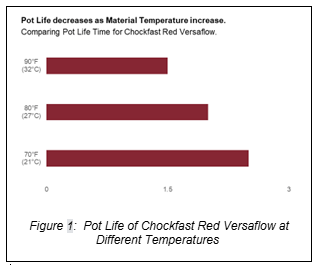
Even modest increases above 85°F (29°C) can dramatically shorten working time. This is a common contributor to summer grouting challenges, particularly for large pours or complex equipment foundations.
Accelerated Cure and Heat Buildup
High temperatures not only reduce working time, they also accelerate the cure process. Figure 2 shows this relationship using Chockfast Red Versaflow as an example.
In warm‑weather conditions:
- Initial set occurs more rapidly
- Peak exothermic temperatures increase
- Internal heat buildup can rise sharply in mass pours
For heat‑resistant grout systems like Chockfast, product formulation helps manage these effects. However, extreme temperatures can still amplify them.
- Excessive exotherm may contribute to:
- Increased internal stress
- Elevated risk of cracking in thick sections
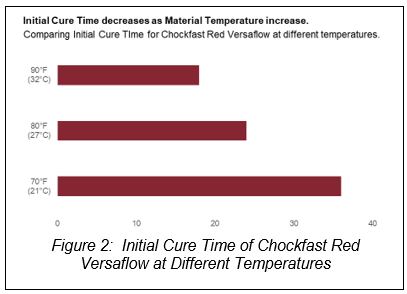
Understanding this behavior is critical when installing heavy equipment foundation adhesives, where dimensional stability and effective load transfer are essential.
Changes in Flow and Placement Characteristics
Warmer temperatures often improve initial flow by reducing viscosity, but this apparent benefit can be misleading.
Fast flow combined with rapid cure requires installers to carefully balance placement speed with accuracy, especially important for high‑temperature structural bonding applications where proper grout contact and uniform load distribution are critical.
Impact on Final Physical Properties
When installed correctly, Chockfast epoxy grouts maintain their exceptional mechanical properties even in hot environments. However, uncontrolled high‑temperature conditions during placement can influence final performance.
Potential risks include:
- Increased shrinkage stress from accelerated cure
- Reduced adhesion when substrate temperatures are excessive
- Surface defects or voids caused by greater expansion and contraction from increased peak exothermic reaction
These risks reinforce why preventing epoxy curing issues begins with understanding temperature‑driven material behavior before installation starts.
Ambient vs. Substrate Temperatures
One frequently overlooked factor in hot weather epoxy application is substrate temperature. Steel and concrete exposed to direct sunlight can be far hotter than ambient air temperatures, significantly affecting epoxy working time.
For example:
- A 90°F (32°C) ambient day can produce steel surface temperatures exceeding 120°F (49°C)
- Elevated substrate temperatures further reduce epoxy working time
This is especially relevant when installing industrial epoxy for extreme heat environments such as refineries, power plants, and mining facilities.
Why This Knowledge Matters to Installers
For installers working in warm climates or summer conditions, understanding the effects of heat on epoxy grout behavior is just as critical as knowing proper mixing and placement techniques.
By recognizing:
- How heat alters working time
- How accelerated cure affects stress development and performance
- How final physical properties can be influenced
Installers are better prepared to apply Chockfast best practices for warm climates, which we’ll cover in detail in the next article. Just remember that Chockfast in high temperatures performs reliably and maintains structural integrity even under industrial conditions. Starting with a heat-resistant grout will lead to success with high-temp structural bonding.
Coming Up Next: Best Practices for Warm‑Weather Installations
This article focused on the why – how heat affects.
In Part 2 of this series, we’ll shift to the how, covering:
- Proven techniques for managing epoxy working time in heat
- Temperature‑control strategies for materials and substrates
- Planning considerations to overcome summer grouting challenges
- Installation best practices to ensure long‑term performance
Look for practical guidance designed to help installers succeed with heat‑resistant grout systems, even under the most demanding warm‑weather conditions.
By: Christopher Matthews-Ewald, Senior Applications Engineer
View all our Technical Data Sheets and Safety Data Sheets. Need some help? Ask a technical question and find a solution!
Further reading: Cheat Sheet: Chockfast® Epoxy Grout Typical Installation Steps and Critical Machinery Installation In Cold Weather? Find Out How To Plan For Success.
For more stories like this, follow ITW Performance Polymers on LinkedIn and sign up for enewsletter in our website footer.