

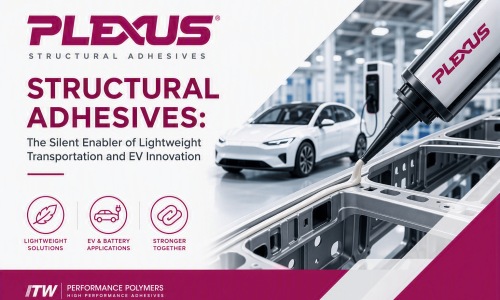
Introduction to Advanced Adhesive Solutions for Bonding Lighweight Materials in EV
In the transportation industry – whether legacy commercial vehicles or the fast-growing electric vehicle (EV) market – the race to reduce weight has become a mission-critical engineering objective. Lightweighting drives efficiency. In internal combustion vehicles, lower weight improves fuel economy and reduces emissions. In EVs, every pound saved directly contributes to greater range, improved thermal performance, longer battery life, and reduced cost of ownership.
To achieve lightweighting goals, OEMs are replacing heavy steel components with aluminum, composites, engineered plastics, and mixed-material assemblies. However, these advanced materials require joining solutions that conventional methods simply cannot deliver. This is where lightweight material adhesives aka EV adhesives, especially advanced acrylic adhesive technologies, are transforming the transportation manufacturing landscape.
Structural EV Adhesives vs. Mechanical Fastening: A Performance Shift
Traditional joining methods like welding, riveting, and screws can create limitations:
- Welding generates heat distortion and is restricted to metals
- Rivets and fasteners add unnecessary weight to lightweight structures
- Mechanical fastening concentrates stress at discrete points, causing fatigue or cracking
- Joining dissimilar materials becomes challenging or impossible
High-strength adhesives eliminate these problems by creating a continuous bond across the surface.
Conventional Joining | Challenges | Industrial Adhesives | Benefits |
Welding | Heat distortion, high energy use, only metals | Bonds metals + composites + plastics | No heat, no distortion |
Rivets/Screws | Adds weight, creates leak paths, stress concentrations | Uniform stress distribution | Lighter structures, fatigue resistance |
Brackets & Fasteners | More parts, more labor, higher costs | Simplified designs | Faster throughput, lower total cost |
Electric vehicle adhesive solutions offer better load distribution, reduced part count, lower weight, and improved crash/impact durability—a combination mechanical joining cannot achieve.
Why Acrylic Structural Adhesives Are the Premier Choice for Lightweighting
Among structural adhesive chemistries—epoxies, polyurethanes, hybrids—acrylic-based structural adhesives provide the optimal balance of speed, strength, and versatility, without major trade-offs.
Key benefits of acrylic structural adhesives:
- Bonds metals, composites, and engineered plastics (SMC, FRP, aluminum, PC-ABS, nylon)
- Fast fixture times for high-throughput manufacturing
- Exceptional impact resistance and vibration durability
- Proven fatigue resistance even under dynamic loading
- No primers needed—making them ideal for automation and scalable production
In lightweight vehicle design, this combination of strength, durability, and throughput is unmatched.
ITW Performance Polymers: The Industry Standard in Lightweight Adhesive Solutions
At ITW Performance Polymers, our Plexus® structural adhesives are engineered specifically for lightweight assembly applications in transportation and EV markets.
- The Plexus MA8000s series delivers industry-leading strength, fatigue resistance, and exceptional impact resistance, making it a go-to adhesive for bonding large composite panels, metals, and engineered plastics.
- Our newest innovation, Plexus MA7020, takes this capability further as a non-flammable, high-strength acrylic adhesive—unique in its class.
Plexus MA7020 delivers the same structural strength and exceptional impact resistance of traditional acrylics, while achieving non-flammability, without trade-offs.
This makes Plexus MA7020 ideal for EV battery enclosures, interior bonding, charging infrastructure, marine, rail, and specialty vehicle applications where safety and compliance are critical.
Together, the Plexus MA8000s portfolio + Plexus MA7020 gives OEM engineers a complete toolkit to bond virtually any lightweight substrate with confidence.
Lightweighting and EV Sustainability Go Hand in Hand in Structural Bonding for EVs
EV adhesives enable sustainable bonding by:
- Reducing vehicle weight → less energy needed for propulsion
- Eliminating thousands of metal fasteners → less manufacturing waste
- Increasing durability and lifespan of bonded assemblies
- Supporting recyclable material use in next-generation vehicle platforms
In EVs, these gains translate directly into greater battery range and improved efficiency.
Conclusion
Lightweighting and bonding lightweight components have become defining metrics of transportation innovation. Structural adhesives, especially advanced acrylic adhesives, are no longer a supporting technology. They are a strategic enabler. They bond dissimilar lightweight materials, reduce weight, improve crash/impact performance, increase durability, and eliminate unnecessary fasteners.
Technologies like Plexus MA8000s and the non-flammable MA7020 are reshaping how engineers design and manufacture tomorrow’s vehicles, making them lighter, stronger, safer, and more sustainable.
Lightweight transportation requires lightweight bonding. And today, structural adhesives are delivering exactly that.
By: Chintan Patel, Product Marketing Manager
View all our Technical Data Sheets and Safety Data Sheets. Need some help? Ask a technical question and find a solution!
Further reading: Thixotropy, Viscosity and Rheology … Oh my!, What is fixture time anyway?, and Is it strong enough?.
For more information like this, follow ITW Performance Polymers on LinkedIn and sign up for enewsletter in our website footer.
ITW Performance Polymers is an international leader in structural adhesives, grouting and chocking compounds, and wear-resistant coatings and repair products. Contact us to learn more about these products and their applications.